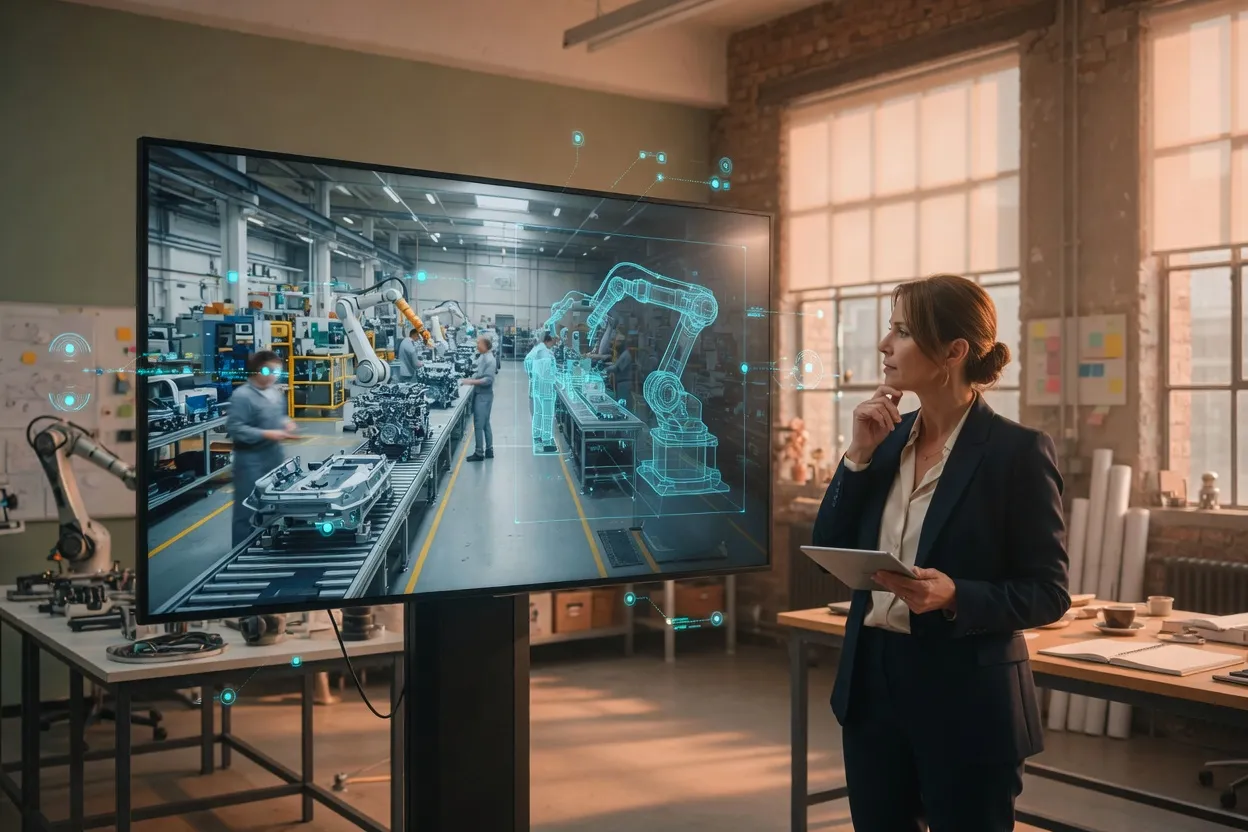
Digital Twins for Operations
Concept & Motivation
The concept of a digital twin — a computational model that mirrors a physical system in real time — has moved from aerospace research to mainstream operations. Manufacturing, energy, healthcare, and logistics are all adopting twins to monitor, predict, and optimize.
But most organizations stall at the dashboard stage: they collect sensor data, display it on screens, and call it a digital twin. A real twin does more. It models the system — dependencies, degradation, capacity, constraints — and uses that model to predict failures, simulate alternatives, and recommend actions.
This course teaches you to design, build, and operate digital twins that actually drive decisions.
What You’ll Learn
- Digital twin maturity levels — from descriptive (data display) to predictive (failure forecasting) to prescriptive (automated optimization). Where your organization sits and where it should aim
- System modeling — representing physical systems as dependency graphs, state machines, and resource networks. First-principles models vs. data-driven models vs. hybrid approaches
- Data acquisition architecture — sensors, SCADA, MES, ERP: what data feeds the twin, how to handle gaps and noise, and the minimum viable data strategy
- Predictive maintenance — condition monitoring, remaining useful life estimation, and maintenance scheduling. The highest-ROI application of digital twins
- Simulation and what-if analysis — running scenarios on the twin: what happens if a machine fails, demand spikes, or a supplier delays? Making plans that survive contact with reality
- Multilayer modeling — production, maintenance, location, and dependency layers interacting in a single twin. How to manage complexity without drowning in it
- Building the business case — ROI of digital twins, starting small, and scaling. Where to begin and what to defer
Who This Is For
- Operations managers and plant managers responsible for production, maintenance, and asset performance
- Maintenance and reliability engineers moving from reactive to predictive maintenance strategies
- IT/OT convergence teams connecting operational technology with data platforms
- Operations directors evaluating digital twin initiatives and vendor proposals
Participants should be comfortable with operational data and process thinking. Prior experience with process modeling (c-bpm-1) or optimization (c-opt-1) is helpful but not required.
Format & Duration
2-day intensive workshop (on-site). Day 1: twin architecture, system modeling, and data strategy. Day 2: hands-on — participants design a digital twin for a system from their own facility, define the data model, and build a predictive maintenance scenario.
What Makes This Course Different
Most digital twin training is either vendor-driven (selling a platform) or stays at the concept level (slides about Industry 4.0). This course teaches you to think in twin architecture — how to model your system, what data matters, and where the decision value actually is.
Participants work hands-on with Aipokit (purpose-built for operational digital twins) and maintenance-monitoring exercises from client deployments. These aren’t demos — you build a twin during the workshop. The modeling concepts transfer to any platform you adopt afterward.
The academic foundation (Grieves’ digital twin paradigm, state-space modeling, graph-based dependency analysis) meets two decades of real-world consulting in production and maintenance across pharma, manufacturing, and energy.