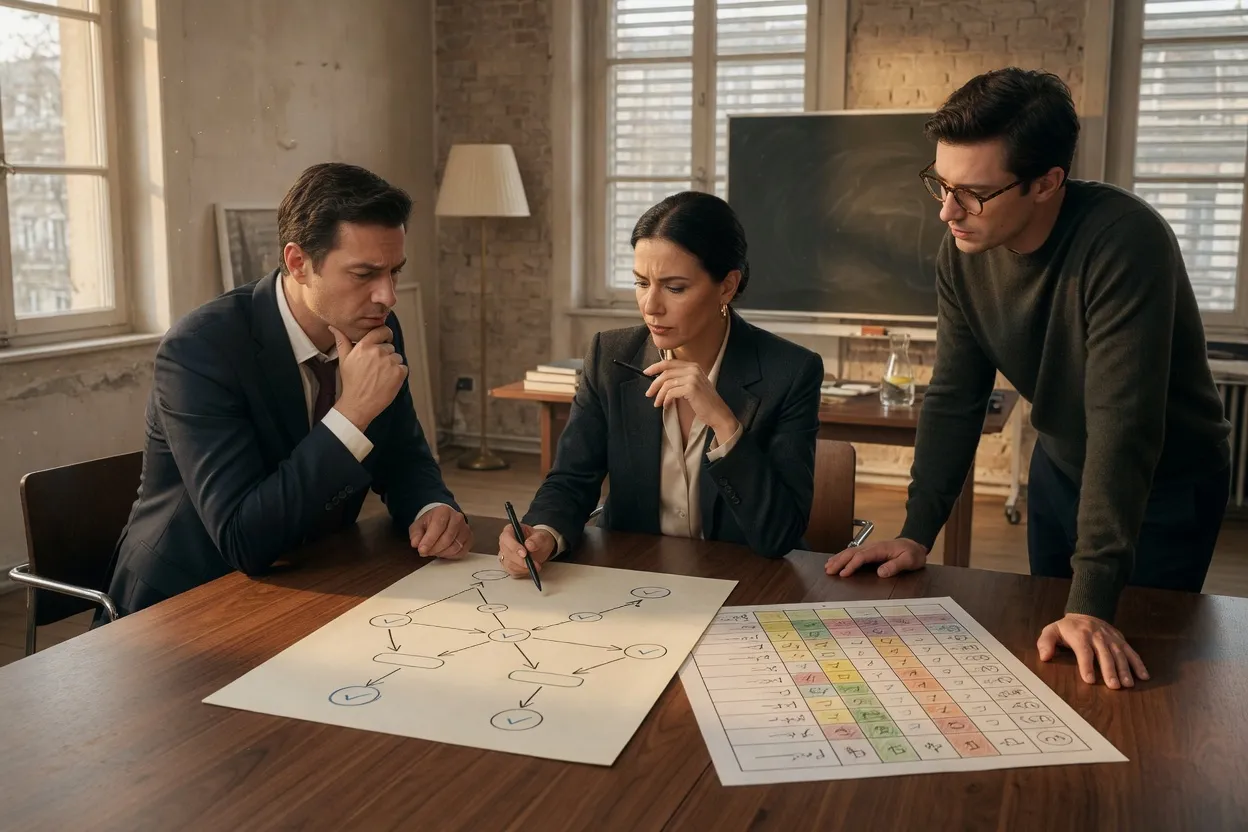
Every manager makes decisions. Few have a systematic method for it.
Decision science is one of the most well-developed fields in academia — Nobel prizes, decades of research, proven frameworks — yet it is almost never taught to the practitioners who need it most. The result: consequential decisions made on intuition alone, post-hoc rationalizations disguised as analysis, and recurring cognitive biases that nobody names.
This seminar translates the best of decision science into tools you can use in your next meeting.
What You’ll Learn
Decision theory foundations — utility, risk, uncertainty, and bounded rationality. Why “rational” doesn’t mean what most people think it means
Decision trees and expected value — structuring sequential decisions with uncertain outcomes, calculating when to invest, wait, or walk away
Scenario planning — building robust strategies that work across multiple futures, not just the most likely one
Bayesian thinking for managers — updating beliefs with evidence instead of anchoring to first impressions. The single most useful mental model in business
Decision support systems — from spreadsheets to AI-augmented dashboards. How technology extends (but never replaces) structured human judgment
Group decision-making — Delphi method, structured debates, devil’s advocate protocols. How to get the best thinking from a team without groupthink
Who This Is For
Senior managers and directors who make consequential decisions with incomplete information and time pressure
Project managers evaluating go/no-go decisions, resource allocation, and vendor selection
Strategy teams building scenarios and investment cases
Anyone who sits in meetings where important decisions get made and wants a better process than “whoever argues loudest wins”
No quantitative background required. The methods are taught with intuitive tools and guided worksheets.
Format & Duration
1.5-day seminar (on-site). Day 1 covers frameworks: MCDA, decision trees, Bayesian updating, scenario planning. Half-day 2 is a decision workshop: each participant applies the frameworks to a real pending decision from their organization and presents their structured analysis.
What Makes This Course Different
Decision science has a reputation problem: it sounds academic, dry, and distant from the messy reality of business. This course fixes that by grounding every framework in real decisions — the kind where stakes are high, data is incomplete, and stakeholders disagree.
The academic lineage (von Neumann, Kahneman, Raiffa, Saaty) gives the methods credibility and rigor. The consulting experience gives them context. Participants don’t just learn AHP — they use it to resolve a real trade-off they’re facing right now.
Q & A
Learn more about what we do
Experience is essential — but it has blind spots. Cognitive biases (anchoring, confirmation bias, sunk cost fallacy) affect even the most experienced leaders. This course doesn't replace your judgment; it gives you structured frameworks that make your experience more effective, especially under time pressure, uncertainty, or stakeholder conflict.
Both. The frameworks come from established academic research (Kahneman, Raiffa, Saaty), but every method is applied to a real decision you're currently facing. You leave with a structured analysis of an actual pending decision — not a homework exercise.
No. The quantitative methods (expected value, AHP scoring, Bayesian updating) are taught at an intuitive level with visual tools and guided worksheets. If you can compare options and assign priorities, you can do this. The math serves the thinking, not the other way around.
One module covers how AI-augmented dashboards and decision support systems extend these frameworks — feeding real-time data into structured decision processes. We demonstrate this with decision-support tooling from our engagements. But the core skill is the human judgment framework; the technology amplifies it.