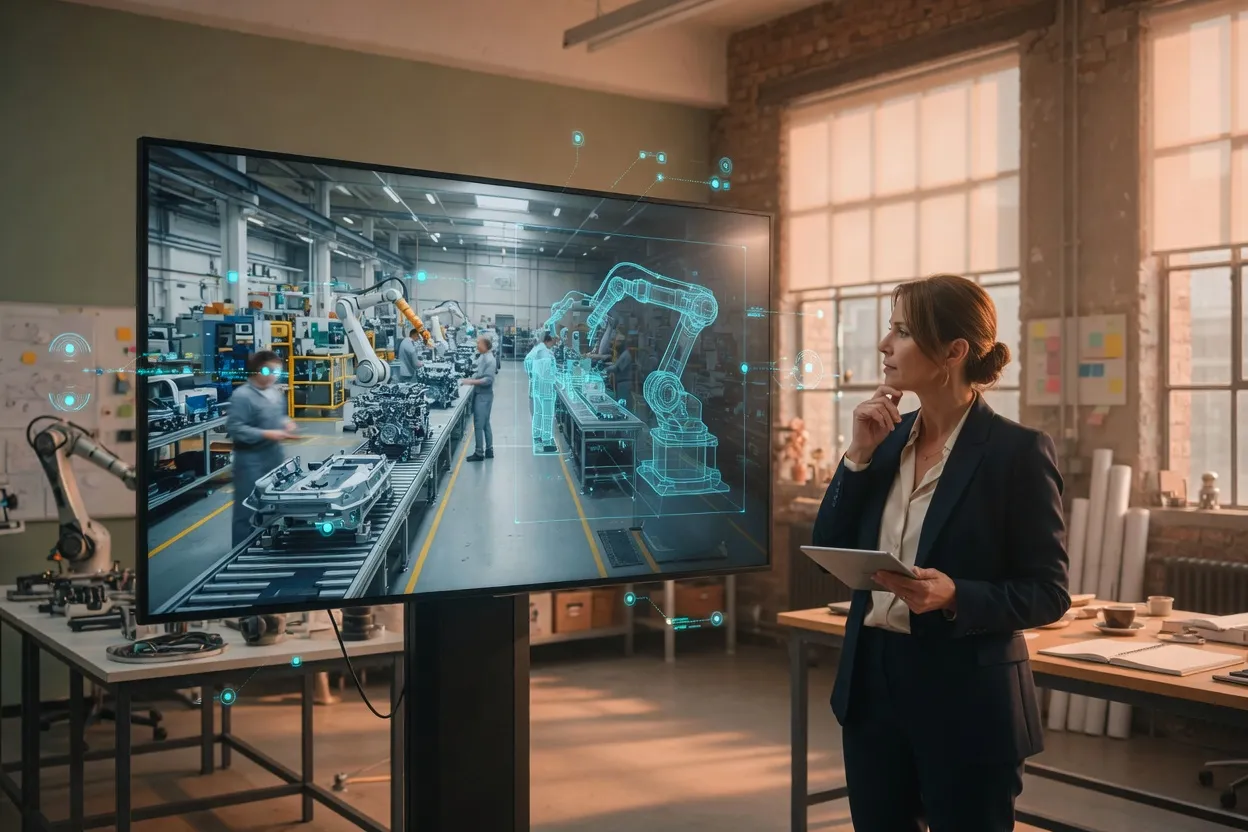
Digital Twins for Operations

Concept & Motivation

The concept of a digital twin — a computational model that mirrors a physical system in real time — has moved from aerospace research to mainstream operations. Manufacturing, energy, healthcare, and logistics are all adopting twins to monitor, predict, and optimize.

But most organizations stall at the dashboard stage: they collect sensor data, display it on screens, and call it a digital twin. A real twin does more. It models the system — dependencies, degradation, capacity, constraints — and uses that model to predict failures, simulate alternatives, and recommend actions.

This course teaches you to design, build, and operate digital twins that actually drive decisions.

What You’ll Learn

  • Digital twin maturity levels — from descriptive (data display) to predictive (failure forecasting) to prescriptive (automated optimization). Where your organization sits and where it should aim
  • System modeling — representing physical systems as dependency graphs, state machines, and resource networks. First-principles models vs. data-driven models vs. hybrid approaches
  • Data acquisition architecture — sensors, SCADA, MES, ERP: what data feeds the twin, how to handle gaps and noise, and the minimum viable data strategy
  • Predictive maintenance — condition monitoring, remaining useful life estimation, and maintenance scheduling. The highest-ROI application of digital twins
  • Simulation and what-if analysis — running scenarios on the twin: what happens if a machine fails, demand spikes, or a supplier delays? Making plans that survive contact with reality
  • Multilayer modeling — production, maintenance, location, and dependency layers interacting in a single twin. How to manage complexity without drowning in it
  • Building the business case — ROI of digital twins, starting small, and scaling. Where to begin and what to defer

Who This Is For

  • Operations managers and plant managers responsible for production, maintenance, and asset performance
  • Maintenance and reliability engineers moving from reactive to predictive maintenance strategies
  • IT/OT convergence teams connecting operational technology with data platforms
  • Operations directors evaluating digital twin initiatives and vendor proposals

Participants should be comfortable with operational data and process thinking. Prior experience with process modeling (c-bpm-1) or optimization (c-opt-1) is helpful but not required.

Format & Duration

2-day intensive workshop (on-site). Day 1: twin architecture, system modeling, and data strategy. Day 2: hands-on — participants design a digital twin for a system from their own facility, define the data model, and build a predictive maintenance scenario.

What Makes This Course Different

Most digital twin training is either vendor-driven (selling a platform) or stays at the concept level (slides about Industry 4.0). This course teaches you to think in twin architecture — how to model your system, what data matters, and where the decision value actually is.

Participants work hands-on with our Aipokit platform (purpose-built for operational digital twins) and MoTo (maintenance monitoring tool). These aren’t demos — you build a twin during the workshop. The modeling concepts transfer to any platform you adopt afterward.

The academic foundation (Grieves’ digital twin paradigm, state-space modeling, graph-based dependency analysis) meets two decades of real-world consulting in production and maintenance across pharma, manufacturing, and energy.


Q & A


Learn more about what we do


A digital twin is a living model of a physical system — a production line, a building, a maintenance network — that stays synchronized with the real world through data. It lets you monitor current state, simulate scenarios, and predict problems before they happen. The concept originated at NASA and has matured into a practical operational tool across manufacturing, energy, healthcare, and logistics.
No. Digital twins apply to any operational system with physical assets, workflows, and data: facility management, fleet operations, hospital equipment, energy infrastructure, logistics networks. The modeling principles are the same. We use manufacturing examples as the primary case study, but the methods transfer directly.
Sensors and dashboards are the visible layer, but a digital twin is primarily a modeling challenge. This course focuses on how to model your system (dependencies, states, degradation patterns), what data you need (and what you can do without), and how to use the twin for decisions — not just for monitoring.
A digital twin integrates both. Process models (from c-bpm-1/c-bpm-2) describe how work flows through the system. Optimization methods (from c-opt-1) help the twin find the best maintenance schedule or production plan. This course shows how these pieces come together in a unified operational model.
Like

Get in touch

Published
On this page
Digital Twins for Operations Digital Twins for Operations Concept & Motivation What You’ll Learn Who This Is For Format & Duration What Makes This Course Different Q & A Learn more about what we do